Betting on the 2026 editions of the NCAA Division I Men’s Basketball Tournament and NCAA Division I Women’s Basketball Tournament is projected to reach around $4 billion in total wagers, according to new estimates from H2 Gambling Capital.
The forecast suggests regulated US sportsbooks will handle roughly 6.7 percent more wagers than the estimated $3.7 billion recorded during the 2025 tournaments. The tournaments begin with early games on 17 March, with the first full round starting 19 March, and will run for approximately three weeks.
According to H2, the increase in betting activity is largely being driven by two factors. First, established regulated betting markets across the US continue to show steady growth in sportsbook wagering. Second, the launch of legal sports betting in Missouri in December has introduced a new pool of bettors just ahead of one of the year’s biggest wagering events.
While Super Bowl LX remains the most heavily wagered single sporting event in the US, March Madness generates the highest cumulative betting volume due to the large number of games played across the tournament schedule.
H2 describes the competition as the most bet-on event in the US sports calendar, largely because of the scale of the tournament and the participation it attracts from casual bettors.
The report also highlights the growing role of prediction market platforms in sports-related trading. H2 estimates that these exchanges could generate around $530 million in handle-equivalent activity during the 2026 tournament. If realised, total wagering connected to March Madness could approach $4.5 billion.
However, as reported by Gaming America, comparing prediction market volume with sportsbook handle can be misleading. Prediction markets count both sides of a trade as volume, meaning a bettor purchasing a contract priced at 20 cents is recorded as a full dollar of activity. By contrast, a $50 sportsbook wager is counted as $50 in handle, making the two figures difficult to compare directly.
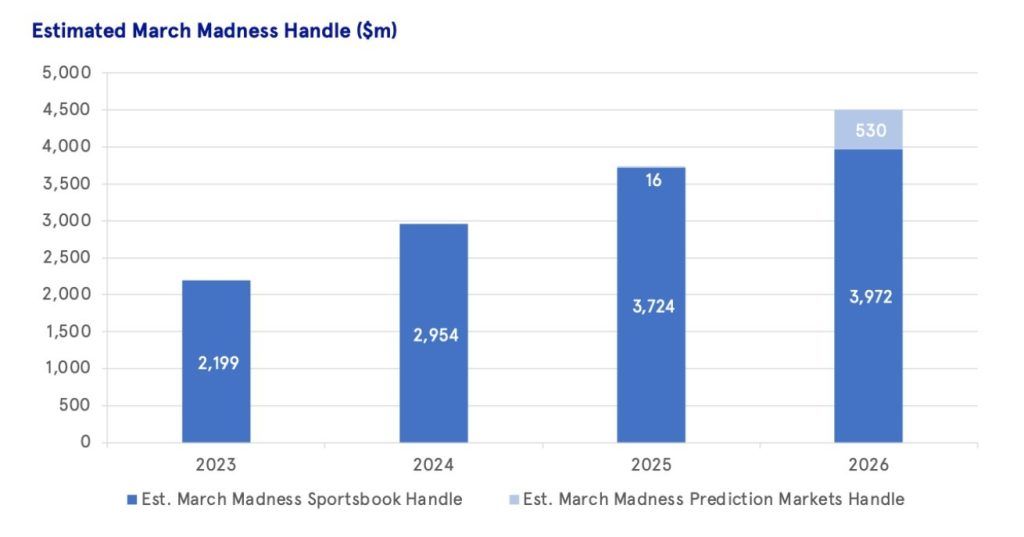
Source: H2 Gambling Capital
The legality of such contracts remains disputed in several states. Some regulators argue they operate as unlicensed gambling products outside state oversight, while the platforms claim they fall under federal supervision by the Commodity Futures Trading Commission. As of March, Kalshi, one of the popular prediction markets platform, is facing legal challenges in multiple states regarding its sports-related betting contracts, with reports indicating a significant wave of litigation across the US.
Despite ongoing legal challenges, tournament-related contracts are expected to be available across the country during this year’s event.
H2’s analysis suggests prediction markets are unlikely to significantly reduce betting volumes at licensed sportsbooks in regulated states. Most activity on these platforms appears to occur in jurisdictions where legal sports betting is not available. In states with established sportsbooks, H2 estimates prediction market trading will represent between $135 million and $150 million in handle-equivalent activity, or roughly 3.5 percent of the projected $4 billion sportsbook handle.
The firm added that the proportion of gross gaming revenue tied to this activity would be even smaller, meaning any softness in sportsbook results cannot be directly attributed to prediction market competition.
#SportsBetting #MarchMadness #USGambling #BettingIndustry #GamingIndustry #Sportsbook #iGaming #BettingMarket #GamingRevenue #GamingNews

Welcome to Gambling Consulting Authority (GCA) - Your Strategic Partner in Gambling Industry Advancement